


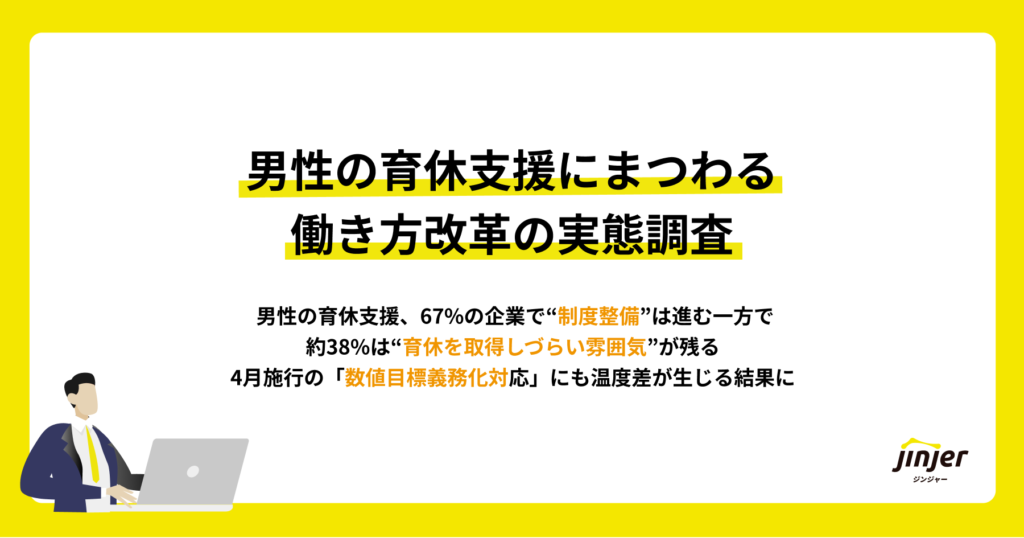
While 671 TP6T firms are making progress in "system development" to support men's maternity leave, about 381 TP6T firms are still in an "atmosphere of difficulty" in taking maternity leave. Results
- The following is content from the press release -
(headquartered in Shinjuku-ku, Tokyo; Ken Tominaga, President and CEO; hereafter "jinjer"), provider of the "jinjer" cloud-based human resources and labor management system, conducted a survey of a total of 361 corporate human resources and general affairs personnel regarding the "actual status of work style reforms related to support for male maternity leave.
Survey Summary
Survey Background
In recent years, social movements to encourage "male participation in childcare" have accelerated. As the government continues to revise the childcare leave system and make it mandatory for companies to set numerical targets (to be enforced in April 2025), companies are also required to implement effective measures to promote the use of childcare leave.
On the other hand, even with systems in place, there are still regional differences and differences in the actual rate of maternity leave take-up depending on the size of the company, and the gap in awareness and culture in the workplace remains an issue. In particular, it has been pointed out that "invisible barriers" such as lack of understanding by managers and coworkers, specialization of work duties, and concerns about promotion have become hurdles in the process of taking leave.
Against this backdrop, the purpose of this survey is to clarify the actual status of support for male childcare leave at companies, as well as issues and initiatives related to childcare leave, and to explore more effective ways to support childcare leave in the future.
Survey Summary
Survey Summary: Survey of Workplace Reforms Related to Support for Male Maternity Leave
Survey method: Internet survey
Survey period: April 14, 2025 - April 15, 2025
Surveyed: A total of 361 corporate human resources and general affairs personnel.
Use of this survey
1 When citing information, please indicate the name of "jinjer, Inc.
2 If used on a website, please place the following link as the source.
URL:https://jinjer.co.jp/
*This release contains only a portion of the nine questions asked. If you would like to know the full results of the survey, please visit the URL below.
▶Survey Results Details:https://hcm-jinjer.com/blog/dx/male_ikukyu_tyousa/
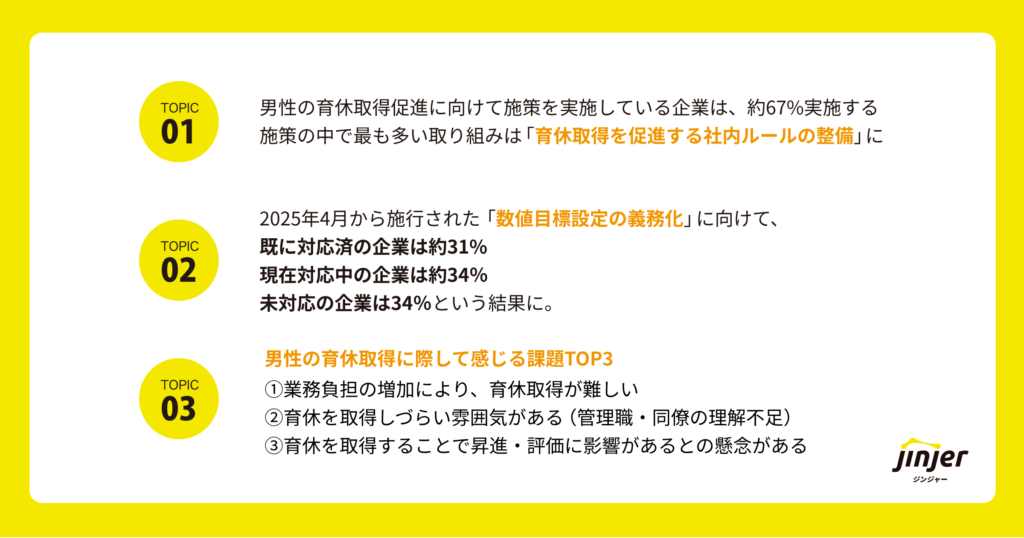
Approximately 67% companies have implemented measures to encourage men to take maternity leave.
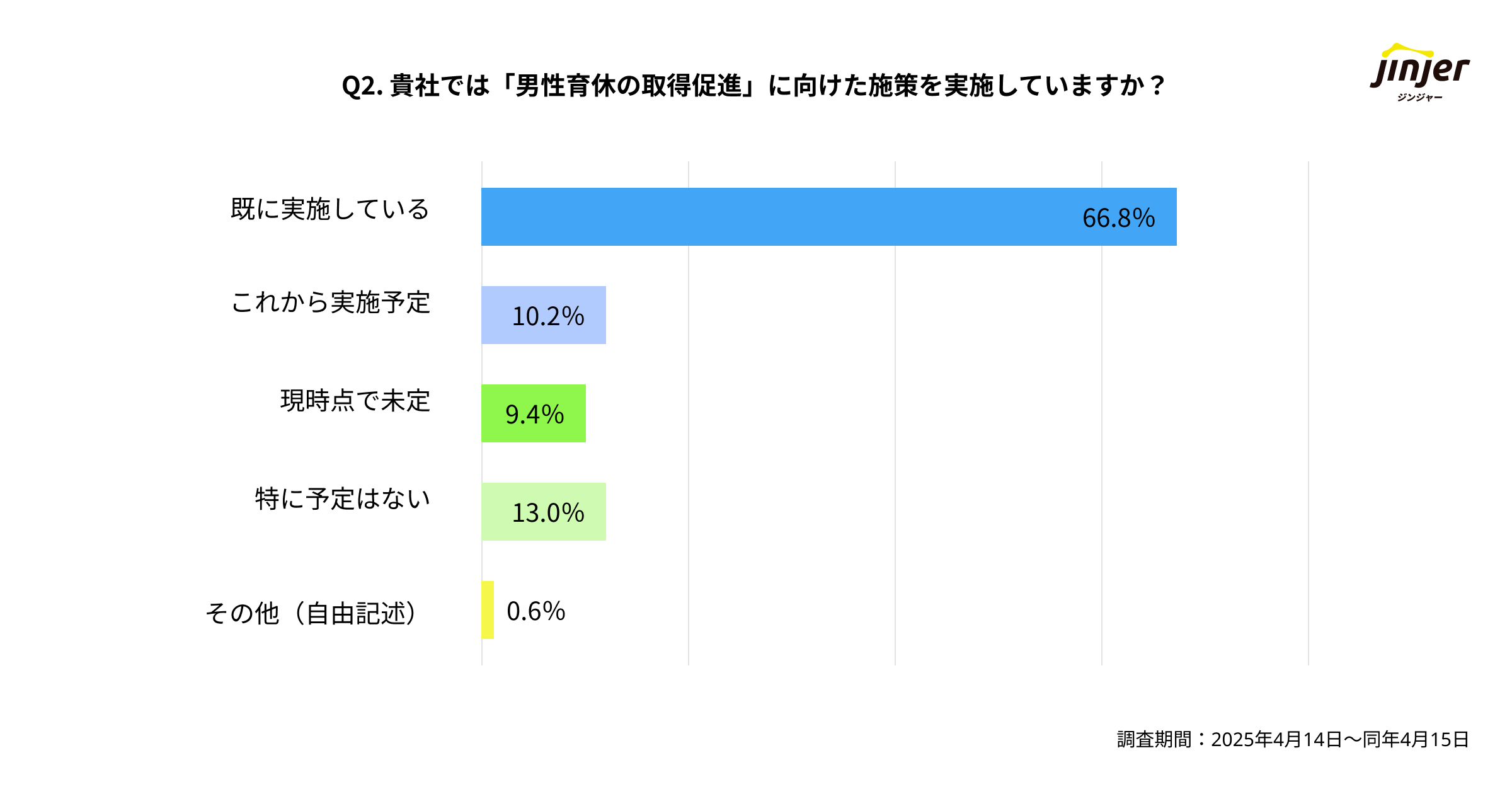
When asked whether they are implementing measures to encourage male employees to take maternity leave, 66.81 TP6T of the companies responded that they "have already implemented such measures. On the other hand, a total of 32.61 TP6T companies have not implemented any measures, including those that "plan to implement measures in the future," "undecided at present," and "have no particular plans.
The most common measure to be implemented is "development of internal rules to promote the use of maternity leave.
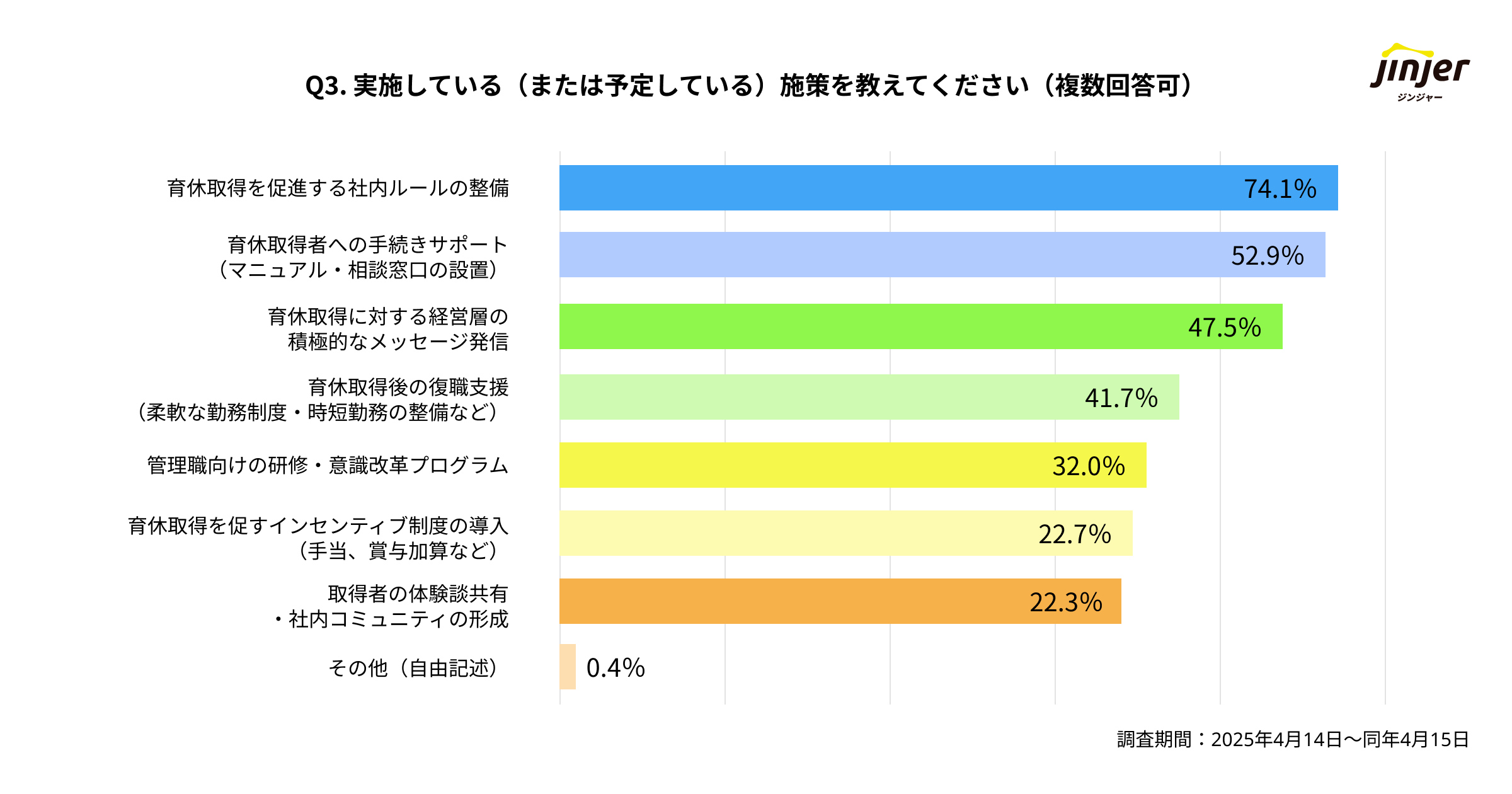
When companies that have already implemented such measures were asked about measures in progress, the most common response was "Establishment of internal rules to promote the use of maternity leave (74.1%). This was followed by "support for procedures for employees taking maternity leave (52.91 TP6T)," "proactive messaging by management regarding maternity leave (47.51 TP6T)," and "support for returning to work after maternity leave (41.71 TP6T).
The most common rate of male employees taking maternity leave in the past year was "1-10%.
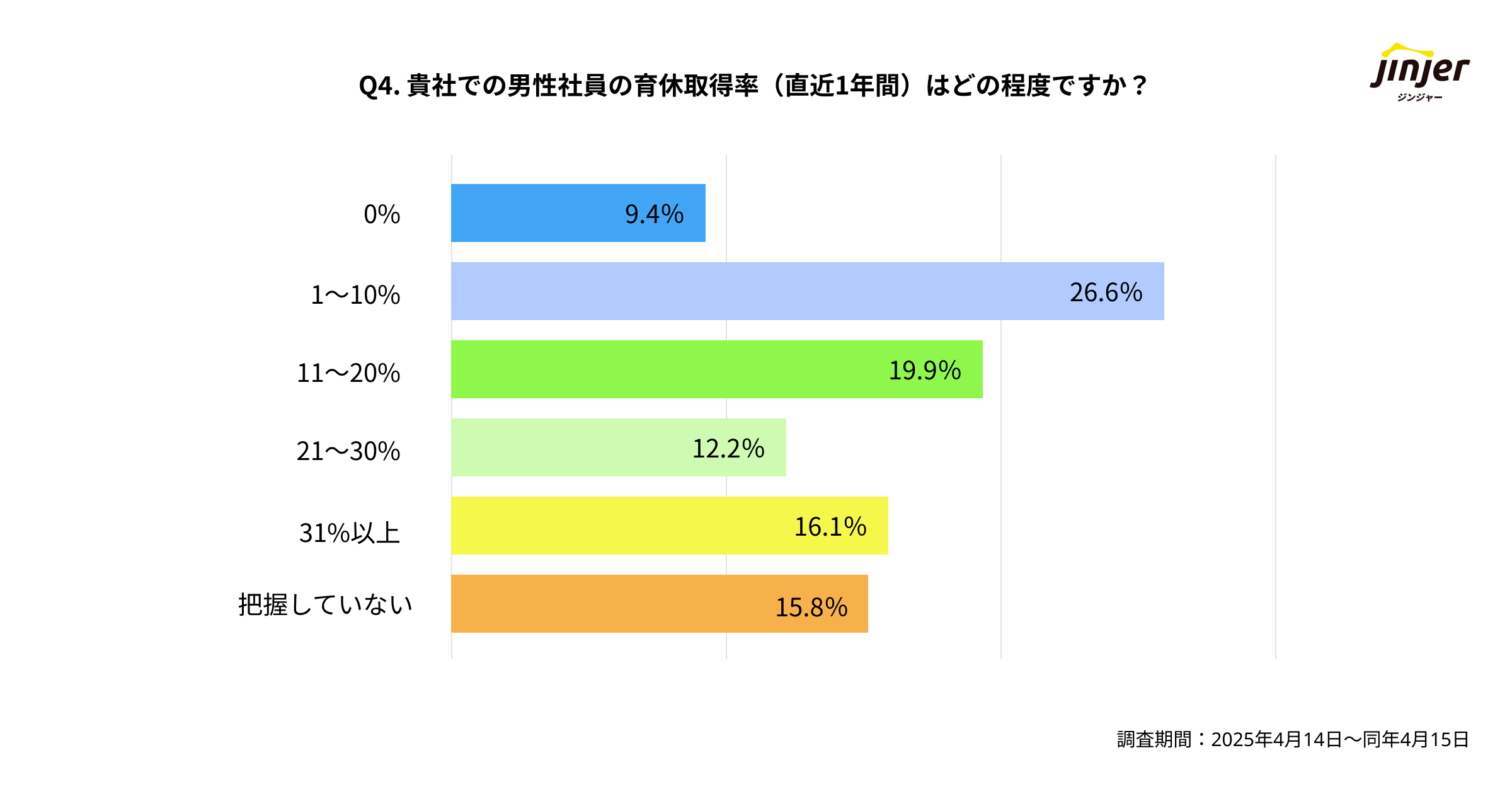
When asked about the percentage of male employees who took maternity leave in the past year, the most common response was "1-10%".
A cross tabulation by number of employees shows that many companies, especially those with 500 or fewer employees, have a "0%" maternity leave take-up rate, while many companies with 1,001-3,000/5,001 or more employees answered "31% or more" for their maternity leave take-up rate.
The most common issue felt by men when taking maternity leave is "difficulty in taking leave due to increased workload.
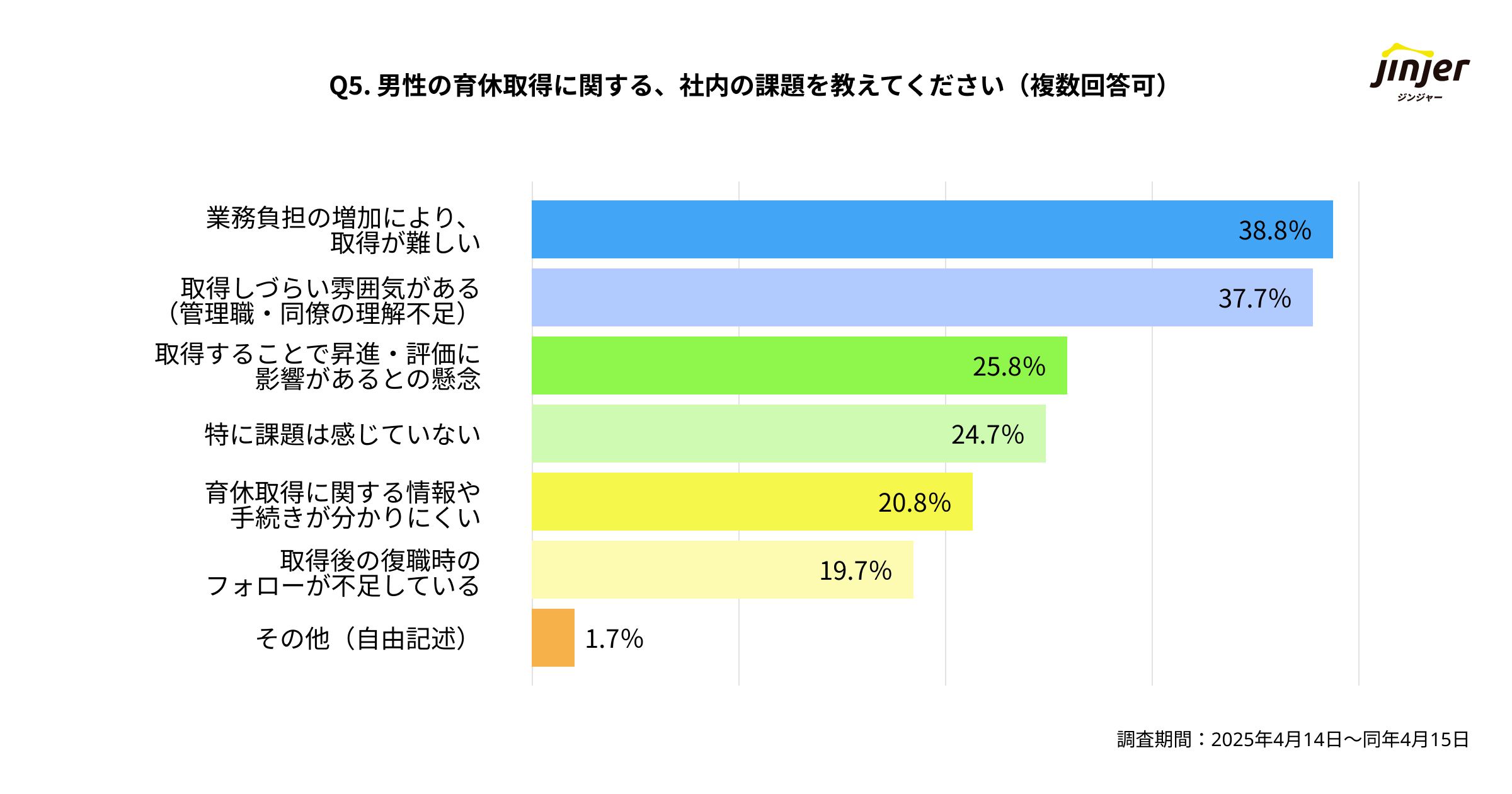
When asked about the challenges they perceive when men take maternity leave, the most common response was "Difficulty in taking leave due to increased workload (38.81 TP6T). This was followed by "an atmosphere that makes it difficult to take leave (lack of understanding by managers and coworkers)" and "concern that taking leave will affect promotion and evaluation.
Approximately 311 TP6T companies have already responded to the "mandatory setting of numerical targets," which came into effect in April 2025.
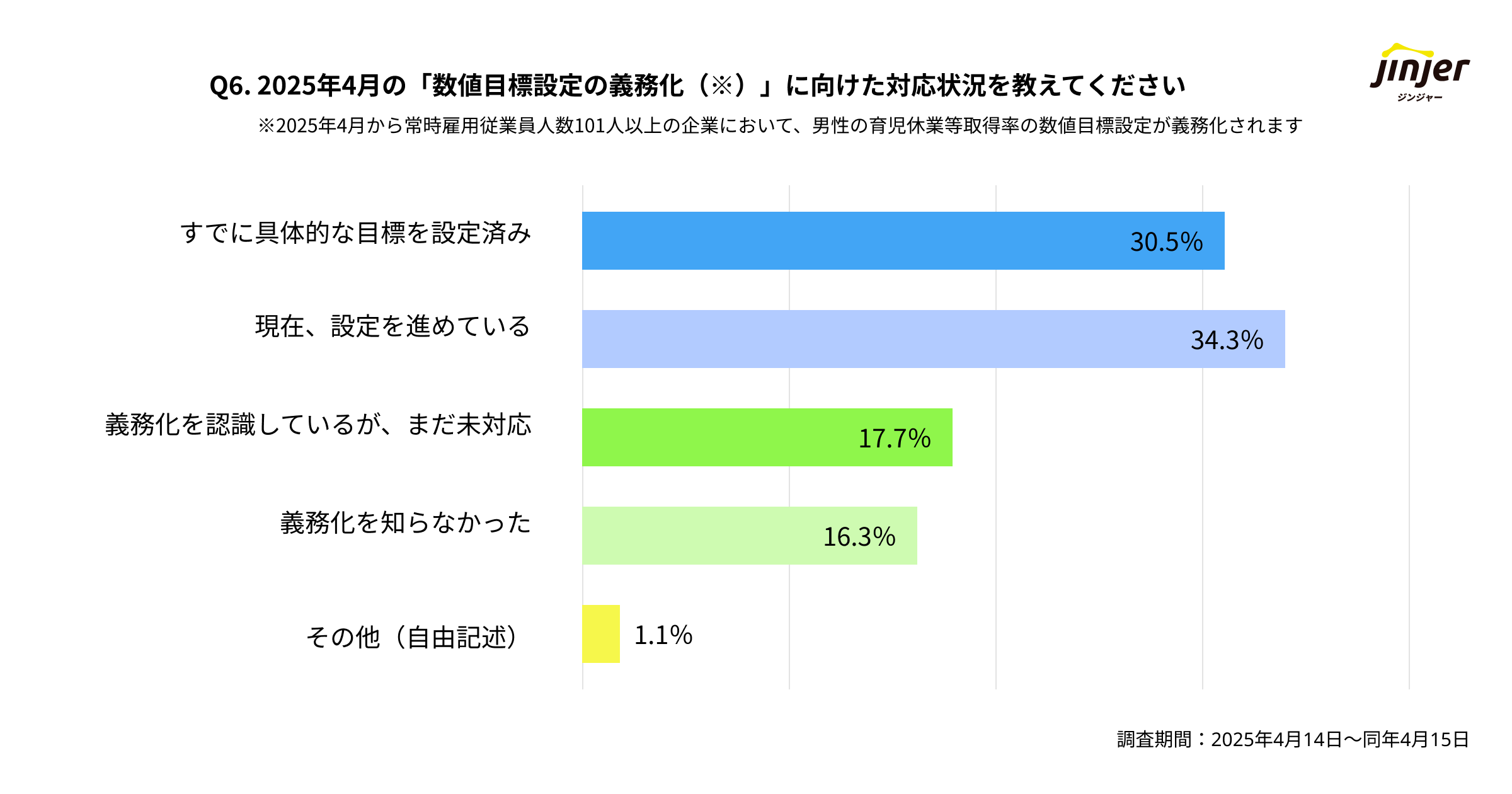
When asked whether or not they are complying with the "mandatory setting of numerical targets," which went into effect in April 2025, about 311 TP6T of the companies have already complied. In addition, about 34% of the companies were currently complying, while 34% were not yet complying.
About 68% of companies believe that numerical targets are effective in increasing the number of men taking maternity leave.
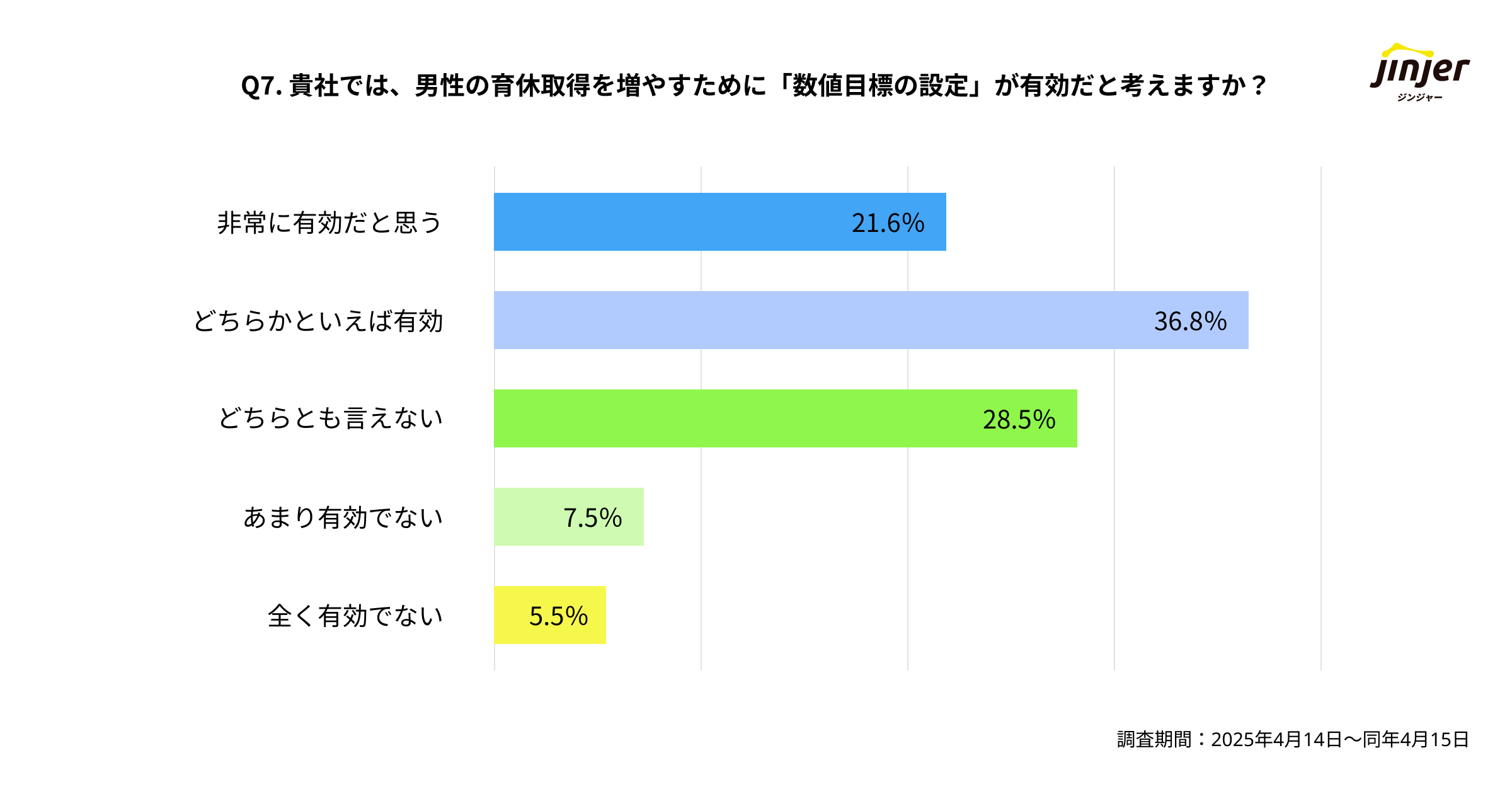
The number of companies that "think numerical targets are effective" in increasing the number of male employees taking maternity leave was 68.4%, including "very effective" and "somewhat effective. On the other hand, 13% of the companies selected "not so effective" and "not effective at all" together.
The most common response to the need to promote male parental leave was "to create a workplace culture that encourages male employees to take leave.
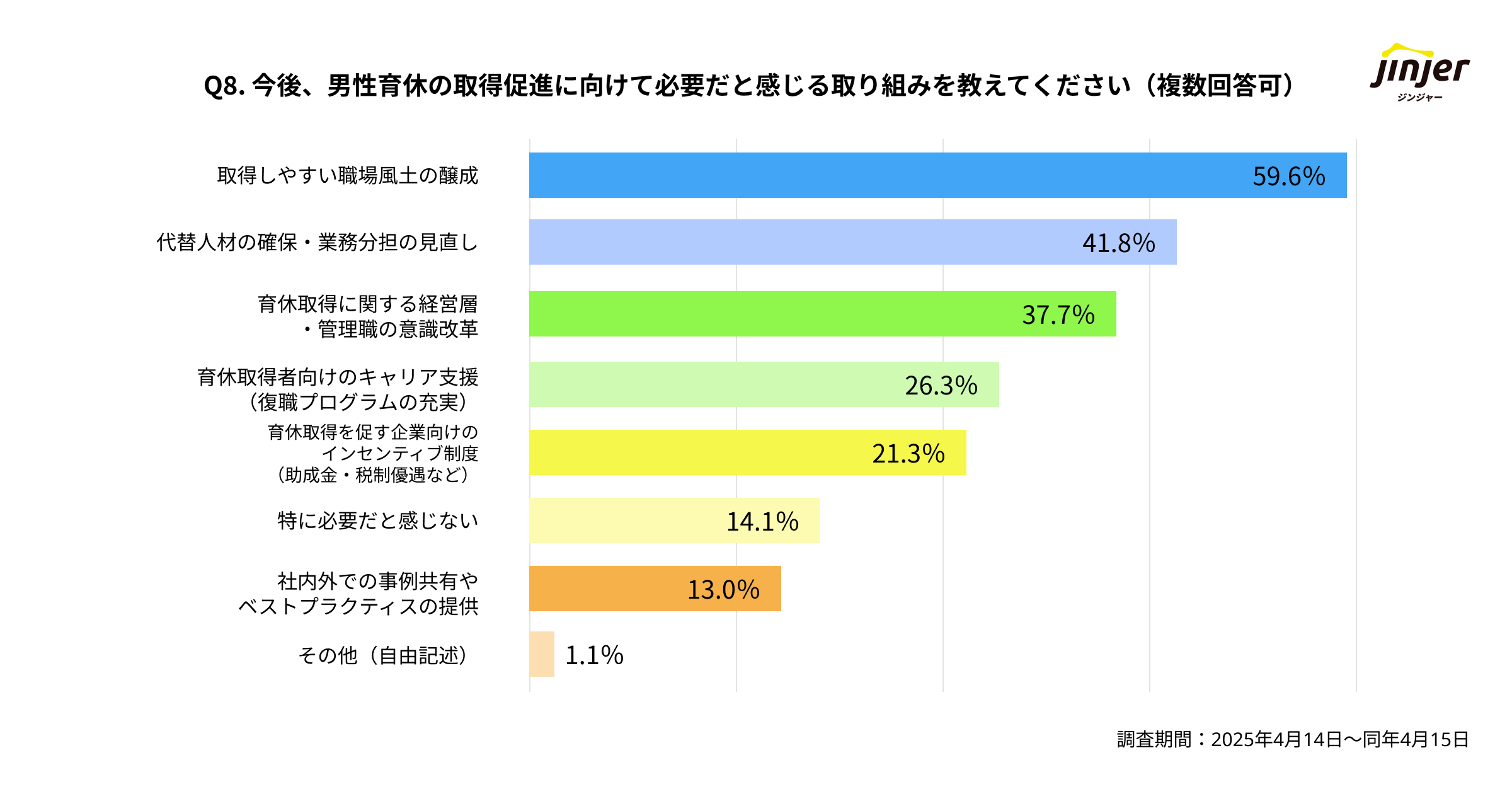
The most common response to the question "Fostering a workplace culture that encourages male employees to take maternity leave (59.61 TP6T)" was "Fostering a workplace culture that encourages male employees to take maternity leave (59.61 TP6T)". This was followed by "securing replacement personnel and reviewing work assignments," "raising awareness of management and managers regarding maternity leave," and "providing career support for those who have taken maternity leave (enhancing return-to-work programs).
The most common support for future maternity leave is to "provide training for managers and executives and foster a workplace culture that encourages maternity leave.
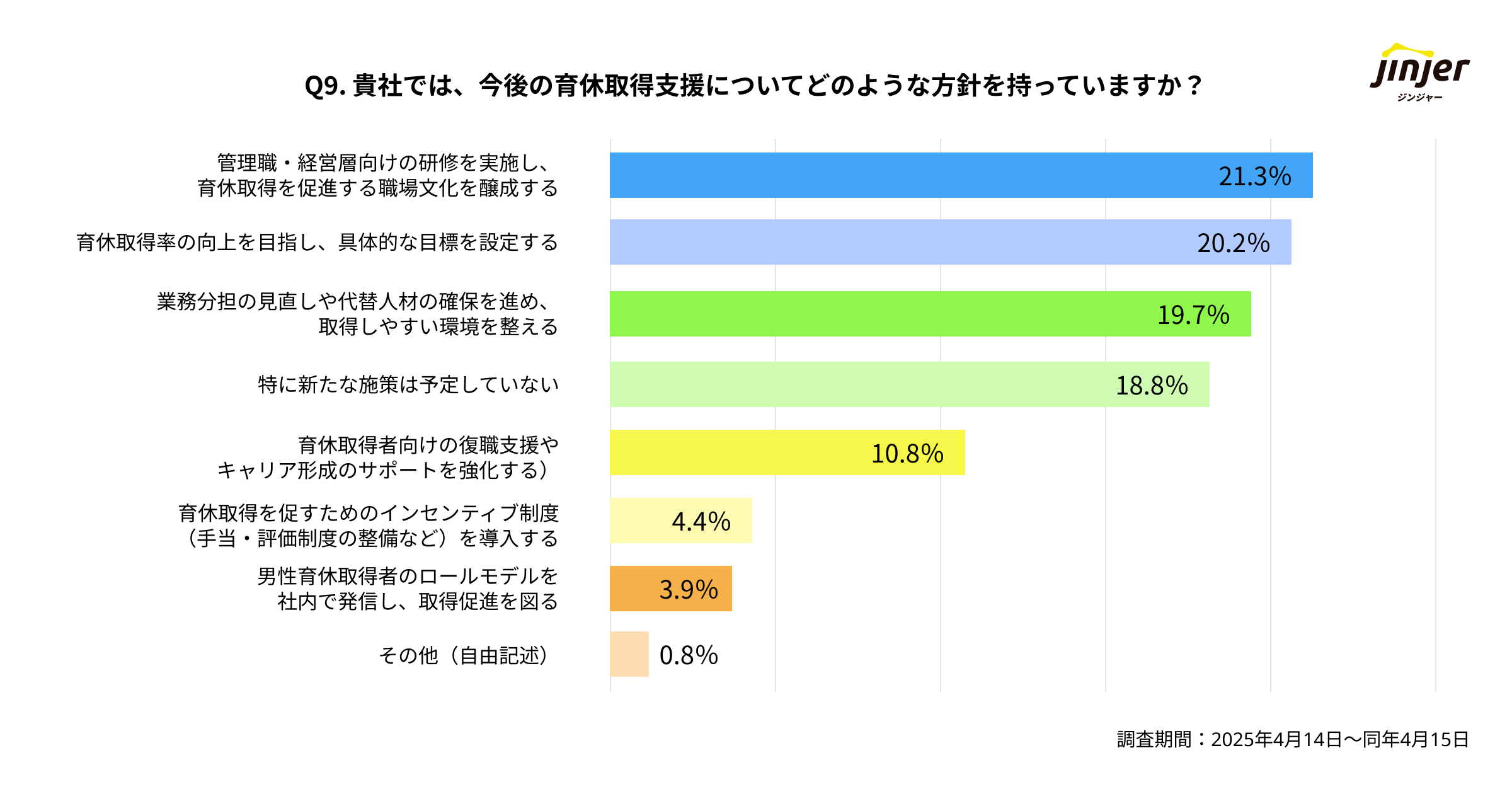
In terms of support for future maternity leave, the most frequent response was "Conduct training for managers and executives to foster a workplace culture that encourages employees to take maternity leave (21.31 TP6T). This was followed by "set specific targets to increase the rate of employees taking maternity leave," "review the division of duties and secure replacement personnel to create an environment conducive to taking leave," and "no specific new measures planned.
Comment from Mr. Suehiro, General Manager, Human Resources & General Affairs Division, jinjer

In recent years, balancing work and childcare has become an important management theme that directly affects the career planning of all workers, regardless of gender. In particular, the participation of men in childcare is one of the changes that can be seen as a symbol of reforms in work styles, and measures such as the establishment of legal systems and the mandating of numerical targets are providing a boost to society.
As this survey reveals, while many companies are working to improve their systems, there is still a significant gap in terms of actual operation and understanding in the workplace. The sluggish growth in the maternity leave take-up rate and comments such as "it is difficult to take maternity leave" highlight the structural issues caused by the gap between the system and the workplace.
What we as an HRSaaS company need to watch closely is the issue of the "system" and "workplace culture" not being "linked. Even if there is a system in place, if it is not operationalized, it will become a mere skeleton. Uncertainty about the timing of reinstatement, mental anxiety, and concerns about the impact on careers (Mommy Tracks) are all factors that prevent individual decision-making.
What is required of companies in the future is to realize a state in which "the system is active" rather than just "the system is in place. For example, it is necessary to review flexible work design and management systems during maternity leave and upon return to work, to address unconscious bias among supervisors and coworkers, and to establish a system of peer support (activities in which people with similar situations and problems support each other). It is also essential to create an environment that allows employees to continue working for a long time by recognizing diversity in the way they perform and expanding domestic support and financial assistance.
Furthermore, from the perspective of human capital management, we believe it is necessary to define the "value of investing in childcare support" as a clear indicator. Specifically, tracking design in both quantitative and qualitative terms, such as "return-to-work rate after taking childcare leave," "performance change after returning to work," and "psychological safety in the workplace," will be an important axis of human capital evaluation in the future.
We want to create a society in which maternity leave is no longer a "special exception" but a "commonplace option. I am convinced that the human resources department should take the initiative in updating the corporate culture and rebuilding the systems and culture to realize this goal, which will greatly contribute to supporting not only women but also men on maternity leave.
What is Ginger, a cloud-based HRM system?
Ginger" is a cloud-based HR system that allows you to manage all of your routine HR tasks, such as personnel and labor management, attendance, and payroll, as well as talent management, such as personnel evaluation and e-learning, in a single system.
The Core HR Database, which integrates HR information into a single database, helps streamline and automate routine tasks such as payroll calculation based on attendance data and the input of forms related to social insurance procedures.
In addition, since the databases of each system are connected, automatic database reflection and changes in privileges to each system in response to changes in roles are realized.
▶ "Ginger" Service Site:https://hcm-jinjer.com
▶ "Ginger" Concept Movie:https://youtu.be/roNBdAmuwAo?si=DPg1MDjtGo7yrrM9
About Us
Company name: jinjer K.K.
Location: WeWork D Tower Nishi-Shinjuku, 6-11-3 Nishi-Shinjuku, Shinjuku-ku, Tokyo
Representative: Ken Tominaga, President and CEO
URL:https://jinjer.co.jp/